Radiused inside corners
A square inside corner funnels stress to one point, and that point is where a crack starts. Cooktop manufacturers specify a minimum corner radius, and we cut every opening to that radius or larger, then polish the cut face.

Rancho Cucamonga Custom Countertops handles countertop cutouts for cooktops and appliances in Rancho Cucamonga, CA, made in the shop to the manufacturer's own drawing for your exact model. Gas, induction, downdraft and flush-mount units each get the right opening, with rounded corners and enough stone left to stay strong. We work with homeowners, builders and cabinet shops across San Bernardino County.
Get a free template visit or a bid
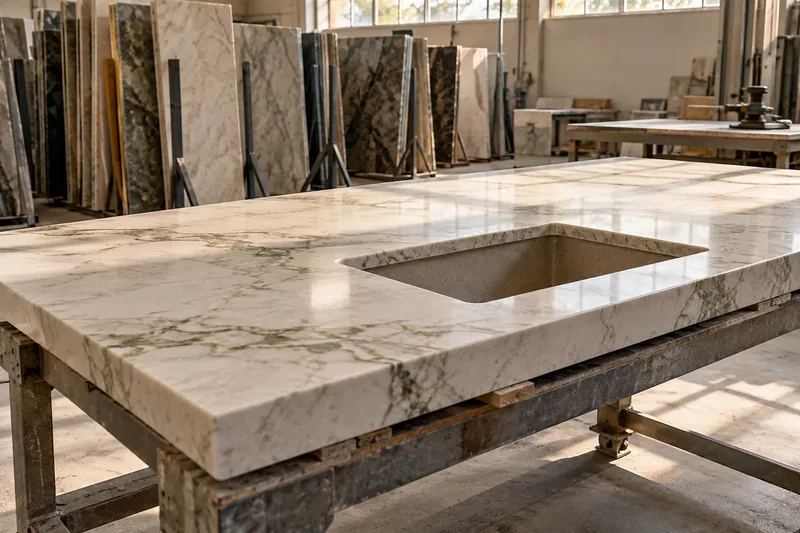
A cutout in stone is a one-time cut, so we make it from the manufacturer's template for the specific appliance you bought. Our team provides shop-cut cooktop, downdraft and flush-mount openings, plus faucet and accessory holes, delivering tops that the appliance drops into without rocking, gaps or forced fits. The same crew that templates your cabinets cuts and sets the stone.
From the rounded inside corners that keep a thin strip of stone from cracking to the rebate under a flush-mount flange, we plan each opening before the saw runs. Serving Rancho Cucamonga, Upland, Fontana and Ontario, we check the layout against your appliance sheets so surprises show up on paper and not on install day.
How we work
Homeowners get a free template visit. Contractors, cabinet shops and builders get tops to their schedule.
Every cooktop and appliance opening we cut follows the manufacturer's installation drawing for that model, because dimensions differ between brands and even between sizes from the same maker. A unit that is a quarter inch too large will not seat, and one that is a quarter inch too small leaves a gap that fills with crumbs and moisture. Stone cannot be filled back in once it is cut, so the drawing is the authority, not a rule of thumb.
To prepare an accurate opening we collect:
If the appliance is backordered, we can cut from the published drawing and tell you plainly that the drawing is what we relied on. You are welcome to confirm the model against that sheet before we start.
An opening is the weakest point of a countertop, and the stone around it carries the weight that the missing material used to share. Good layout is mostly about leaving enough stone in the right places, which is why we review the plan with your appliances before we fabricate. These are the points we check on every cutout:
A square inside corner funnels stress to one point, and that point is where a crack starts. Cooktop manufacturers specify a minimum corner radius, and we cut every opening to that radius or larger, then polish the cut face.
A narrow strip of stone between a cooktop and a sink, or between an opening and the front edge, is the usual place a top fails. We measure that strip at the template, and if it is too thin we propose sliding the cooktop over a little.
Where a slab spans a gap, such as a cooktop above a drawer bank, we plan hidden steel rods or a support rail so the stone does not flex when it is carried and set.
The appliance sheet sets the clearance to the cabinet below and to nearby surfaces. Many induction units also need airspace beneath them for cooling, and we leave that space in the plan.
Different appliances call for different openings, and each has its own detail. We fabricate these in the shop, in quartz, granite, quartzite and porcelain slabs, with the specifics set by the manufacturer's drawing:
The most common opening. The cooktop's flange rests on the stone around the cutout, and the opening has to be accurate enough that the flange covers the edge all the way round.
The glass top sits on or in the stone, and the opening has to leave the airspace and electrical access the unit calls for beneath it.
A slot cut beside or behind the burners for a vent that rises from the surface. It adds a second opening that has to be planned for strength.
The unit sits level with the top rather than above it, which needs a recess milled from below the stone. Shop work only.
Warming drawers, built-in trash pull-outs, pop-up outlets, plus holes for a faucet, soap dispenser and filter tap, all drilled and finished to spec.
Openings on tops we build are folded into the job price, so the figures here matter mainly for extra cuts and for work on stone that is already in your house. An additional appliance or accessory opening is typically estimated at roughly $100 to $300, and cutting a new cooktop opening into an existing top is typically estimated at roughly $250 to $700 once the stone has been inspected.
The price moves with:
Every number here is an estimate for Rancho Cucamonga and can shift with the appliance and the condition of the stone. The quote you sign after templating lists each opening on its own line and fixes the final price.
A new or larger opening in an existing top is sometimes possible, but only after we confirm the stone can take it. Upgrading to a wider cooktop, adding a downdraft or moving an appliance means removing material from a slab that was never designed for that hole. Whether it works depends on what is left around the cut.
Before we agree, we review:
Sometimes the honest answer is that the top should be replaced, or that the appliance should move to a better spot. Hearing that on day one beats hearing a crack in the shop.
An appliance cutout touches more trades than the stone, so we plan around them. Gas lines, electrical feeds and ventilation come through the cabinet below the opening, and the people who run them need to know the position of the cutout before the top is set. We share the layout with your builder, cabinet installer or electrician so everything lines up on install day.
We cut and install the stone, but we do not connect gas or electrical service. A licensed trade does that after the top is in place and the appliance is set.
For remodelers and cabinet shops, send the appliance sheets with the cabinet drawings. We check them against each other and flag any conflict, such as a drawer that would hit a cooktop's underside, before anything is cut.
The process
Four steps, and nothing is cut until you have approved the slab and the seam layout.
Homeowners book a free template visit. Contractors and builders send the appliance sheets and cabinet drawings for a bid.
We match each appliance to its installation sheet and decide opening positions, clearances and hole locations with you.
The openings are cut with water on the blade, the corners are rounded and the cut faces are polished.
We set the stone, test the fit of each appliance opening and leave hookup to your licensed trades.
Questions
The main cooktop opening is built into the price of a top we make, while each extra opening is typically estimated at roughly $100 to $300. Cutting into stone that is already installed is quoted after we inspect it. These are estimates, and the final figure is whatever appears on your signed quote once the template is done.
We need its exact model number at minimum, and the unit itself is better. Each manufacturer publishes a cutout drawing with width, depth, corner radius and clearances, and we cut to that sheet. If the appliance is still on order, we work from the published spec and tell you that is our source.
Sometimes, if there is enough solid stone around the new opening and the top is well supported. We look at the span, seams and nearby cutouts first. If the new hole would leave a thin, weak strip, we recommend moving the appliance or replacing the section instead of risking a crack.
A sharp inside corner concentrates stress, and that is where stone cracks first. A rounded corner spreads the load across more material. Most cooktop makers specify a minimum corner radius for exactly this reason, and we hold to it on every opening.
The appliance sits level with the surface of the stone instead of resting on top of it. That needs a recess milled in the underside of the slab so the cooktop's flange can drop in. It is precise shop work and cannot be done properly with the top already on the cabinets.
Yes. A downdraft needs a narrow slot beside or behind the burners, and sometimes a second opening below. We check that enough stone remains between the slot and the cooktop opening, and we tell you if the layout needs a little extra support.
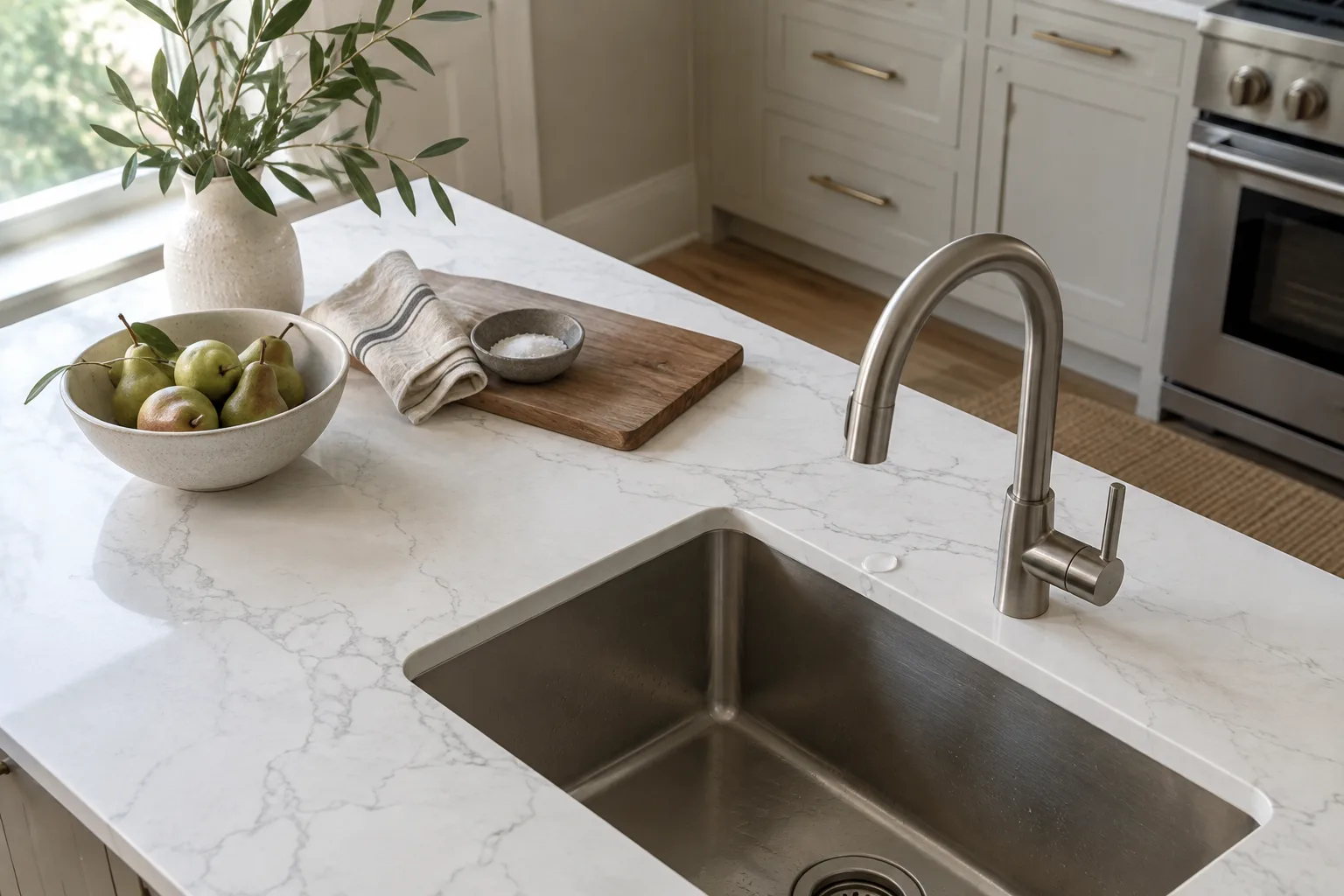
They are, and we drill them at the shop bench. Tell us the faucet model and any extras such as a filter tap, soap dispenser or air switch at the template visit, and we mark and drill them to the spec sheets.
No, a freestanding or slide-in range sits in a gap between two runs of countertop and needs no opening. We still template the cabinets on each side so the stone meets the range cleanly. A cooktop above a wall oven or drawers is the case that needs a cutout.
Homeowners get a free template visit. Contractors and builders can send appliance sheets and drawings for a bid.
Licensed, bonded & insured · License #585047. Calls only, we do not receive text messages.