Skip to content
Call (909) 922-1858Licensed, bonded & insured · License #585047

Seamless Countertop Joining & Seam Matching in Rancho Cucamonga, CA

No stone countertop is truly seamless, but with seamless countertop joining & seam matching in Rancho Cucamonga, a well-made joint is one you have to hunt for. Rancho Cucamonga Custom Countertops plans, matches and bonds seams on new tops across Rancho Cucamonga, CA, and repairs joints that have opened, stained or sit out of level on tops someone else set.

  • Free template visit
  • Seams approved before a cut
  • One written quote

Get a free template visit or a bid

What seam matching really involves

Seam matching is the planning, cutting and bonding that makes two pieces of stone read as one surface. It covers where the joint goes, how the pattern continues across it, how tightly the edges meet and how level the pieces sit. We work it out with you at the template visit and show the plan on your slab before cutting.

A slab is only so long, so most L-shaped kitchens, long walls and large islands need at least one joint. Serving Rancho Cucamonga, Upland, Fontana and Ontario, we treat each seam as a design decision rather than an afterthought, and we also fix seams that other installers left open, cracked or uneven.

How we work

Seams Planned Before the Saw Runs

A seam you approve on paper tends to be one you barely notice on the counter.

Placed on purposeJoints sit over solid support and away from the sink and cooktop
Pattern followedVeining and movement are lined up so the eye travels across the joint
Tight and levelEdges are pulled together and set flush, then the line is polished smooth
CA License #585047Licensed, bonded and insured

Why Seams Exist and Where They Belong

Seams exist because slabs come in fixed sizes, typically around nine to ten feet long, and many kitchens are longer or more complicated than that. An L-shaped run, a wall of cabinets that exceeds a slab, or a large island with an overhang almost always needs a joint, and a good fabricator plans for it from the start.

Where the joint falls matters as much as how it is made. These are the placement rules we follow:

  • Away from the sink. Water and cleaning products work on a joint every day, so we avoid putting one directly beside an undermount opening when the layout allows it.
  • Away from the cooktop. Heat cycling is hard on adhesives, so we keep seams clear of a range opening where we can.
  • Over cabinet support. A joint should rest on solid cabinet framing, never float across an open span or a dishwasher gap.
  • At natural breaks. Corners and changes of direction let the eye accept a joint, which hides it better than a line down the middle of a straight run.
  • Clear of weak spots. Narrow necks of stone between a sink and an edge, or around a cooktop opening, are prone to cracking, so the layout keeps them wide.

Placement is decided with you present

We walk the room with you at the template visit, mark proposed joints on the cabinets and discuss them. You may prefer a seam on one side of the window over the other, and we can usually accommodate that if the slab and support allow it.

Matching the Pattern Across a Joint

Pattern matching is the difference between a seam that interrupts the stone and one that continues it. Quartz, which is made to be uniform, joins easily, and its seams are usually the quietest. Natural stone is more demanding, because veins and clouds run in particular directions and must meet on both sides. A photograph of the slab goes under the template layout, and the pieces are nudged around until the movement lines up. For a premium look, two consecutive cuts from the same slab can be book-matched, so the pattern reflects like an open book. That uses extra stone, so we discuss the added cost before committing.

Natural stone with movement

Marble, quartzite and bold granite need the most attention. The grain has to carry through, and the pieces are cut in order from the slab so neighbors stay neighbors. We show the layout so you can approve how the veins meet.

Engineered and uniform stone

Quartz and similar surfaces can be joined very closely because the color is consistent. Patterns with directional veining still need pieces oriented the same way, and we check the direction marks on each slab before cutting.

How a Seam Is Made

A good seam starts in the shop and finishes on site, and each stage affects how visible the line will be. The mating edges are cut straight and dry-fit before the pieces ever leave the shop, so we know they meet. On install day the crew sets both pieces, draws them together with seam setters and checks that the faces are flush with a straightedge. A color-matched epoxy fills the gap, and once it cures the excess is scraped and the line polished to blend with the surrounding finish. Careful joining leaves a hairline that most visitors never find.

In the shop

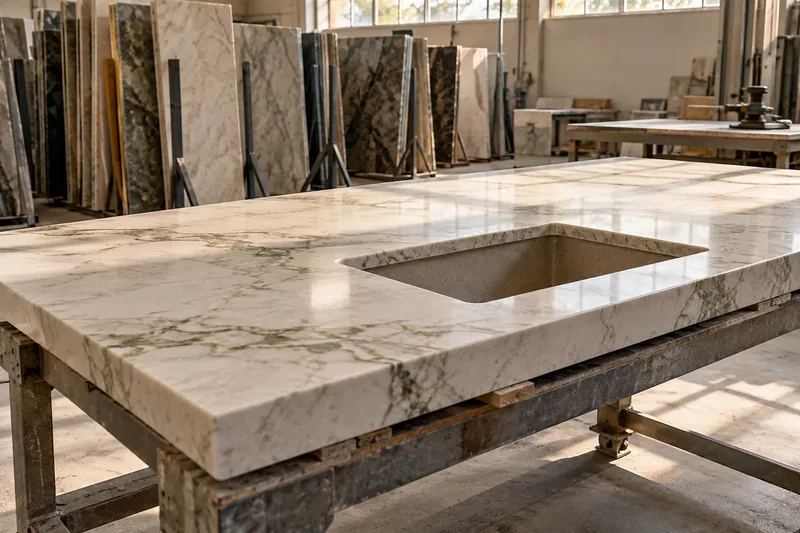
Edges are cut straight, ground and test-fit so the gap is as narrow as the stone allows. We note the piece order and orientation so the crew sets them as planned.

On install day

Pieces are set level, drawn tight and bonded with tinted epoxy. We watch for lippage, which is a slight height difference between pieces, and correct it before the adhesive cures, then polish the line.

Estimated Costs for Seam Work in Rancho Cucamonga

Seams on a new top we install are part of the job price, and repair of an existing seam is typically estimated at about $200 to $600 per joint in Rancho Cucamonga. These are planning estimates only, and the written quote fixes the amount once we have looked at the joint.

  • New seams on our own installs. Planning, matching, bonding and polishing are included in the countertop price.
  • Book-matched pieces. The extra slab yield is what moves the estimate, since mirrored layouts use more stone than a standard layout.
  • Separated or cracked seams. We inspect, re-bond and re-fill, and the estimate depends on whether the cabinets underneath are level and solid.
  • Discolored epoxy lines. Cleaning out the old filler and re-filling with a matched color is quoted after inspection.
  • Uneven pieces. Fixing lippage may mean releveling the cabinets before the stone is reset.

A seam repair will not hold if the cause is movement underneath. If the cabinet boxes sag or a shim has failed, we tell you so, because re-gluing a joint over a moving base only delays the next crack.

Fixing a Failed or Ugly Seam

A seam that has opened, cracked, yellowed or sits proud of the surface can usually be repaired without replacing the top. The first step is working out why it failed. Common causes include cabinets that were never leveled, a joint set over an unsupported span, too much adhesive, a color that was never matched and heat or moisture around a sink.

Once we know the cause, the repair follows. For a hairline separation, we clean the gap and re-fill it with matched epoxy. For a joint with lippage, we may need to release and reset one piece so the faces line up, then polish. A cracked section near a sink corner sometimes needs a reinforcing strip bonded beneath the stone.

We look at the joint in person before quoting, since photos hide height differences and hollow spots. If the damage is beyond what a seam repair can fix, we say so and talk through options such as replacing a single piece.

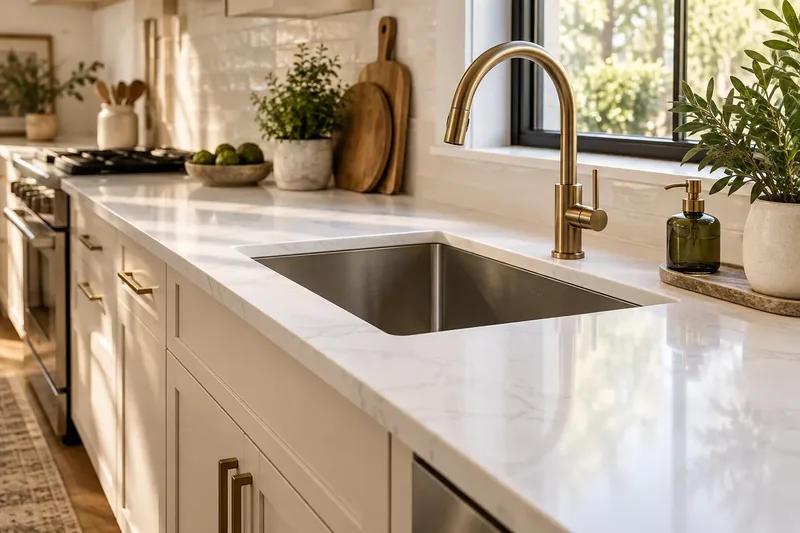
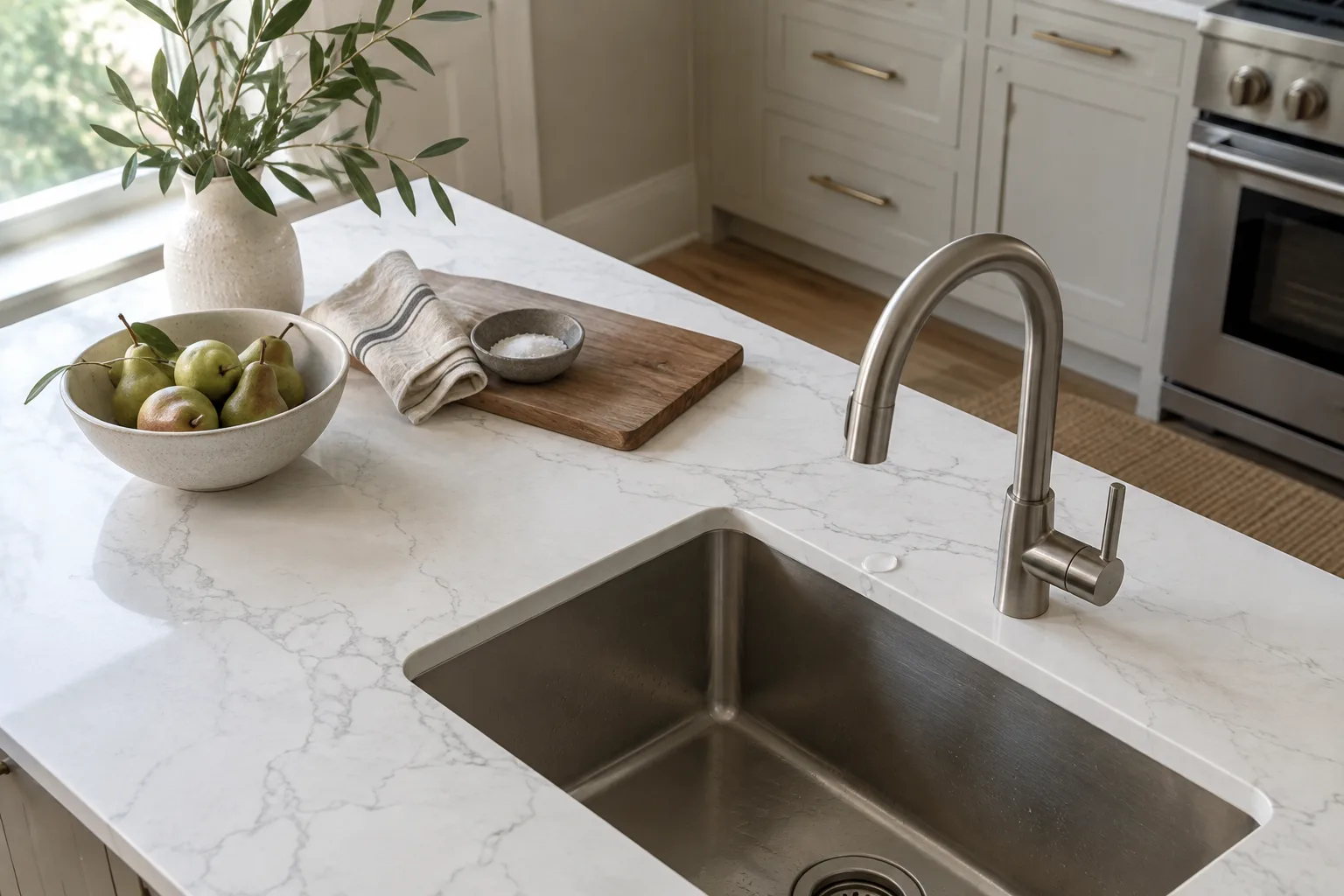
White quartz counter run with faint grey veining, a stainless undermount sink and a brass gooseneck faucet

Preparing Your Kitchen for a Clean Joint

The cabinets decide how good a seam can be, because stone sits on whatever is beneath it. A seam over cabinets that are out of level will show a step no matter how skilled the installer is. We check the boxes at the template visit and flag anything that needs shimming or reinforcement before the stone arrives.

  • Level the run. The top edges of cabinets joined by a seam should sit on the same plane.
  • Support the joint. A rail or frame member should sit under the seam line, with no open gap beneath it.
  • Choose the finish with the seam in mind. A honed surface can hide a joint better than a glossy one, while glossy stone shows every difference in height.
  • Keep fixtures out of the joint. Faucet and cooktop openings should not break right through a seam if the layout can avoid it.

On install day, keep the room clear and the plumbing disconnected so the crew can work the full run without moving things around the joint.

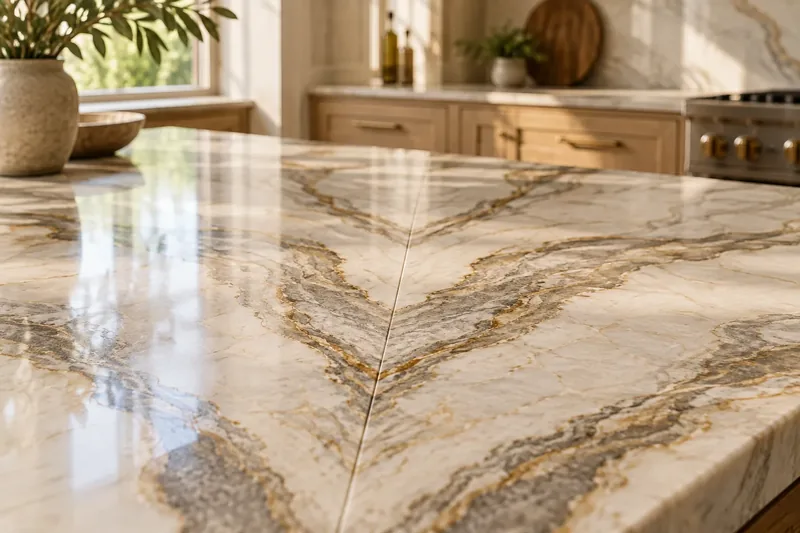
Quartzite counter with gold and grey veining book-matched so the pattern mirrors across the seam

Seams and Pattern Matching in Finished Tops

The process

From Seam Plan to Polished Joint

Four steps, and no cut is made until you have seen where each seam falls and how the pattern meets.

  1. Reach out

    Homeowners book a free template visit. Contractors send drawings and the finish list for a bid.

  2. Plan the seams

    We mark the joints on your cabinets and on a photo of the slab, and you approve the layout.

  3. Cut and fit

    The pieces are cut in order and test-fitted in the shop so edges meet tightly.

  4. Bond and polish

    The crew sets the stone, fills the joint with matched epoxy, levels it and polishes the line.

Questions

Seamless Countertop Joining: Common Questions

Will I be able to see the seam?

You will find it if you look for it, since two pieces always leave a line. A well-placed joint with a matched pattern and tight edges goes unnoticed by most guests until a finger crosses it.

Is a seam avoidable in my kitchen?

Probably not. A slab tops out near nine or ten feet, so a longer wall or an L-shaped layout calls for a joint, and planning it well beats wasting a second slab to dodge it.

How much does seam repair cost in Rancho Cucamonga?

Repair of an existing seam is typically estimated at about $200 to $600 per joint, depending on the cause and the finish. We give the firm figure in writing after an inspection.

Where is the best place for a seam?

Usually at a corner or a natural break, over solid cabinet support and away from the sink and cooktop. We mark proposed spots in your kitchen and you approve them.

Can you match veining across a joint?

Yes. On stone with movement we overlay the template on a slab photo and align the veins by eye. Book-matching two consecutive pieces makes the pattern mirror, with extra slab required.

Which materials hide seams best?

Quartz and busy, speckled granite hide a joint well. Stone with long, directional veining takes more planning, since the lines need to meet on both sides.

Can a cracked seam be repaired without replacing the top?

Often yes. We find the cause, then re-bond and re-fill the joint, and in some cases reset one piece. If cabinets underneath are the problem, they come first.

Do you repair seams other installers made?

Yes. We inspect the joint in person, say whether it can be saved, and quote the work before starting.

Free template visit

Talk to us about seamless countertop joining and seam matching

Free template visit for homeowners. Contractors can send drawings for a bid on new tops or seam repairs.

Call (909) 922-1858

Licensed, bonded & insured · License #585047. Calls only, we do not receive text messages.

Call (909) 922-1858Licensed, bonded & insured · License #585047