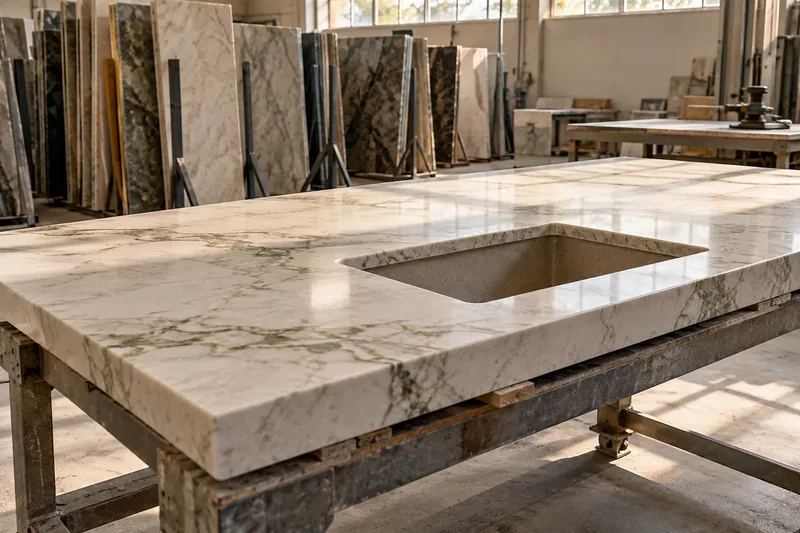
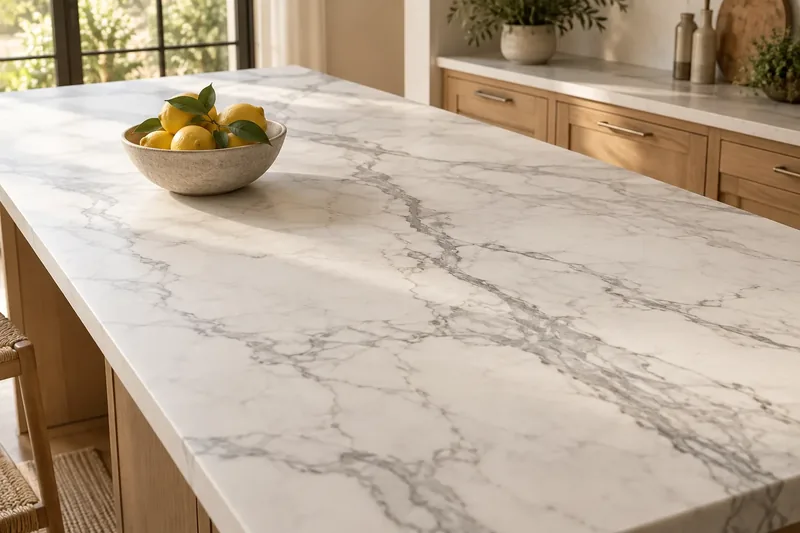
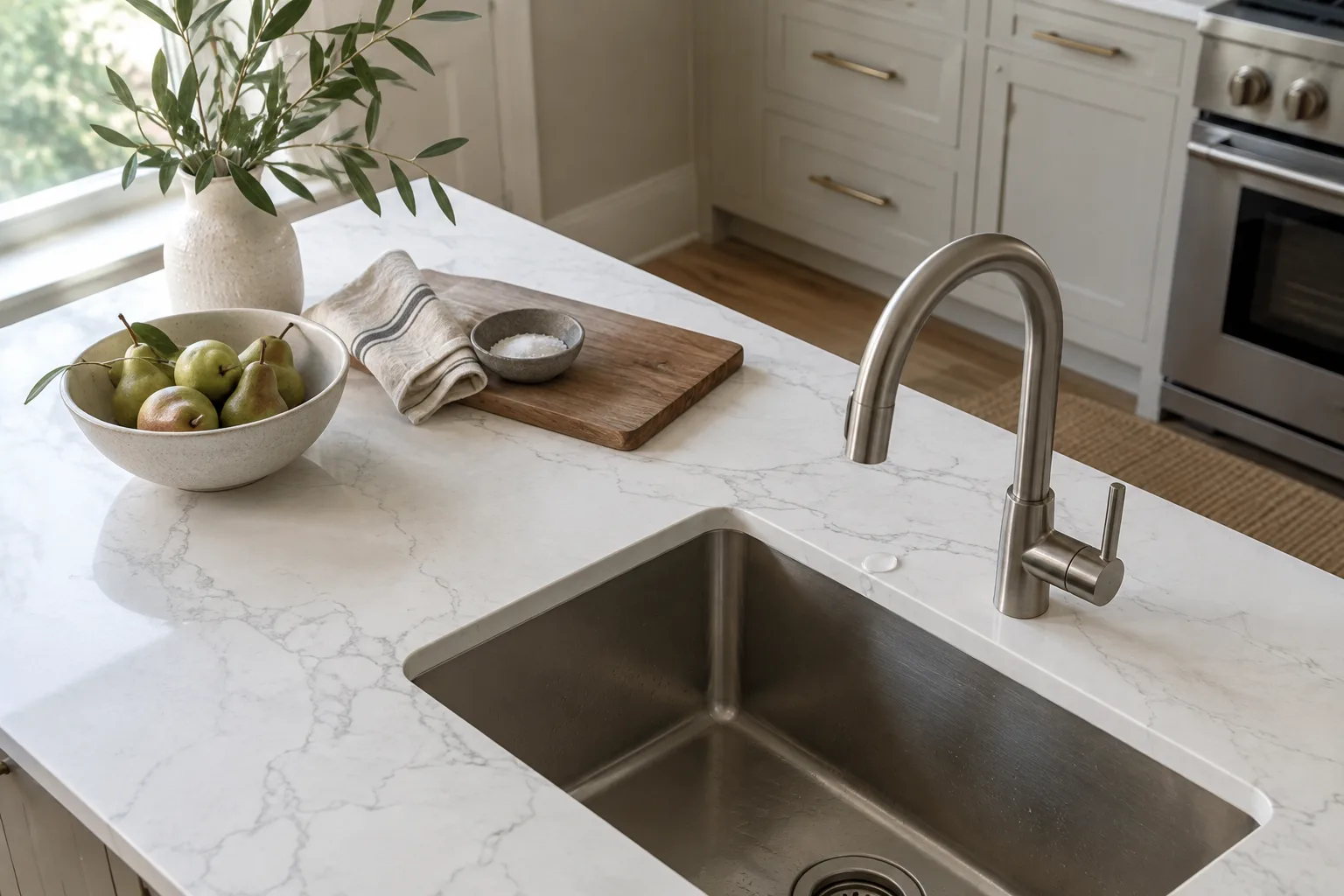
Honed
A smooth, matte surface with a soft glow. It hides etching and footprints, and it feels less slick underfoot, which suits baths, kitchens and entries.

Rancho Cucamonga Custom Countertops specializes in marble floor resurfacing & refinishing in Rancho Cucamonga, CA, bringing dull, etched and scratched marble floors back to life by grinding, honing or polishing and sealing the stone you already own. Foyers, baths, kitchens and living areas can look freshly laid again without demolition. We work in homes across San Bernardino County.
Get a free template visit or a bid
A marble floor loses its look long before it wears out. Acids etch it, grit scratches it and foot traffic dulls it, yet every one of those flaws sits in the top fraction of an inch. We use diamond abrasives and water to remove that layer, fill what needs filling and seal the stone so it can be enjoyed again.
Our crew does the grinding, honing, polishing and sealing on foyers, powder rooms, baths and open living areas. Serving Rancho Cucamonga, Upland, Fontana and Ontario, we inspect the floor first and recommend only the level of work it needs, so you do not pay for a heavy grind where a light polish will do.
How we work
Homeowners get a free template visit. Contractors, cabinet shops and builders get tops to their schedule.
Marble can be refinished because the color and veining run through the full thickness of the stone, with no wear layer to burn through. A surface coating, by contrast, is only a film, and a film peels, yellows and shows foot paths. When we remove a hair-thin layer of stone with progressively finer diamond pads, the damage goes with it, and what remains is the stone itself.
Several kinds of damage respond well to this process:
Deep stains and old oil that have traveled well into the stone may need a poultice or may fade only in part. We tell you what we expect before we start, because marble varies from one quarry to the next.
The finish is a design decision as much as a repair, so we show samples on your own floor before the full grind begins. Each one is made mechanically, with diamond pads and water, which is why none of them wears off like a wax or topical sealer does. Here is how the three common choices differ:
A smooth, matte surface with a soft glow. It hides etching and footprints, and it feels less slick underfoot, which suits baths, kitchens and entries.
A mirror-like reflective surface that brings out the depth of the veining. It looks formal and bright, and it shows etching and wear a little sooner than a honed floor.
A middle path with a gentle sheen, popular in open living areas where you want some light play without a full mirror finish.
Floor restoration follows a fixed order, and skipping a step shows later as swirls, patches or a floor that dulls early. We work in this sequence on every room, adjusting the starting grit to the damage we find at the inspection:
We check thickness, flatness and the type of damage, then test a small area to confirm the finish before touching the rest of the floor.
Chips, cracks and pits are packed with matching epoxy and failed grout is replaced, so each repair finishes level with the floor.
Coarse diamond pads flatten lippage and remove deep scratches, then each finer pad erases the pattern left by the one before it.
If you choose a polished finish, final pads and a polishing compound bring up the shine across the whole floor.
A penetrating sealer goes into the stone so water and oil bead off, with no film on top, and we show you how to clean the floor from here on.
Restoring a marble floor in place is typically estimated at roughly $3 to $9 per square foot, with light polish and seal work at the lower end and heavy grinding with repairs at the higher end. A small powder room or bath may carry a minimum charge, which is typically estimated at roughly $350 to $900 for the room. Filling a handful of chips or cracks is usually included, while extensive tile replacement is quoted separately.
The price depends on these things:
These figures are estimates for Rancho Cucamonga and will vary with your floor. Your written quote, made after we inspect it, sets the final price.
Not every floor can be saved, and we say so when it applies. Grinding removes stone, so a floor that has been refinished several times may have too little left to take another pass. A tile that cracked because the subfloor moved will crack again until the base is fixed. Thin marble over a flexible substrate can chip when ground.
At the inspection we look at:
If restoration is not the right route, we point you to the better one, which may be a repair, a partial replacement or a new floor.
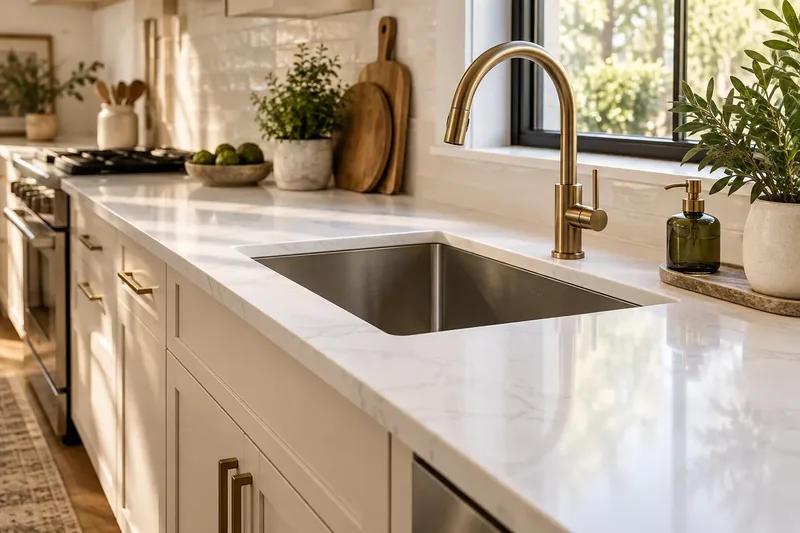
Marble, travertine and limestone are all calcium-based stones, so they share the same weakness to acid and the same cure. Marble is dense and takes the highest polish, travertine has natural pits that are filled before honing, and limestone is softer and usually looks best honed. We identify the stone before we choose pads and compounds, because a method that suits one can mar another.
The same crew can also care for the matching surfaces in your home, from a marble vanity top to a stone fireplace surround. That helps the finish stay consistent from floor to counter.
Natural stone is a living material, with veining and tone that change from tile to tile. Refinishing brings out that character rather than hiding it, and the result looks like your floor at its best, not like a new product.

The process
Four steps, and nothing is cut until you have approved the slab and the seam layout.
Tell us the rooms, the stone and what bothers you about the floor.
We check thickness and condition and test a small area so you can see the finish.
We repair, flatten and refine the floor, then seal it, working one section at a time.
We walk the floor with you and show you the daily cleaning routine that keeps it looking good.
Questions
Yes, in most cases, because marble is the same stone through its full depth and a very thin layer can be ground off to reveal fresh stone in the finish you choose. Etch marks, light scratches and traffic dullness are removed, not covered. The exceptions are a floor already ground several times and tiles cracked by a moving subfloor.
Usually, by a wide margin. A typical restoration is estimated at roughly $3 to $9 per square foot depending on condition, while new marble plus demolition, disposal and setting costs several times that. These are estimates, and the written quote after we inspect the floor sets the final number.
Choose honed for baths, entries and busy family areas, and polished for formal rooms where you want the shine. Honed is matte, hides etching better and is less slippery when wet. Both finishes are made with diamond abrasives and water, never with wax.
A single room is often finished in two to three days, including drying and sealing, and a larger floor plan takes longer. Heavy lippage or deep scratches add grinding passes. We confirm the schedule when we inspect, and you can stay in the home while we work in sections.
Less than most people expect, because the grinding is done wet and the slurry is contained and vacuumed up. We mask doorways and protect baseboards and cabinets. Plan to keep pets and children out of the working room until the floor is dry and sealed.
Small chips, hairline cracks and pits are packed with a matching epoxy before polishing begins, which lets the patch blend in with surrounding tiles. A crack that comes from subfloor movement will return unless the base is addressed first, and we tell you if that is the case.
Yes. Travertine and limestone are calcium-based like marble, so they etch from the same acids and respond to the same grinding and honing steps. Travertine also needs its natural voids filled before honing, which we do as part of the work.
Use a neutral pH stone cleaner, put mats at the doors and wipe up acidic spills such as wine, citrus and vinegar quickly. Skip generic bathroom cleaners, which etch the surface. We show you the routine at handover and reseal when water stops beading, often every few years.
Our crew will look at the floor and price only the work it needs. Call or send the form for a free assessment.
Licensed, bonded & insured · License #585047. Calls only, we do not receive text messages.