
Waterfall Edge Countertops With the Vein Carried Down the Side
Rancho Cucamonga Custom Countertops is San Bernardino County's leading specialist in waterfall edge countertops in Rancho Cucamonga, CA, specializing in mitered waterfall islands, peninsula waterfalls, and double-sided waterfall panels. We offer quartz waterfalls and marble or quartzite waterfalls cut for continuous veining.
- Free template visit
- Seams approved before a cut
- One written quote
Get a free template visit or a bid
Or call (909) 922-1858. Calls only, we do not receive text messages.
About our waterfall edge countertops
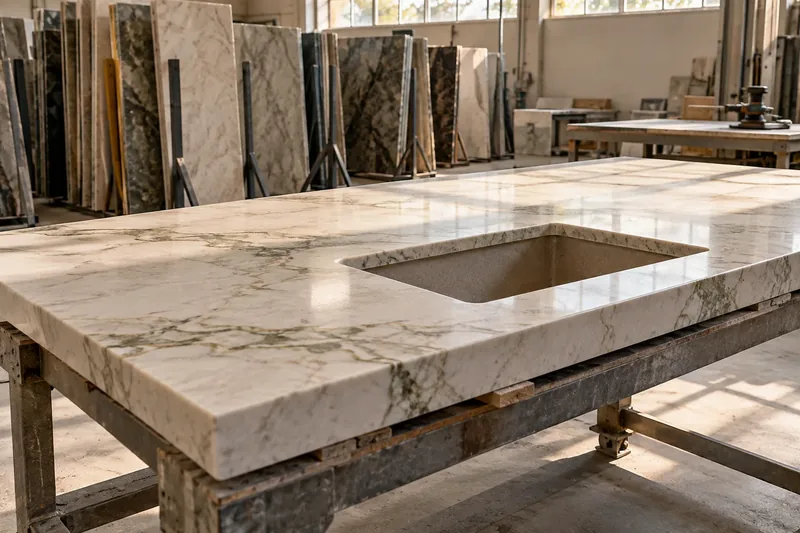
Our team provides vein-matched slab layout across every corner, delivering sculpted countertops for homes and long-lasting finishes for both residential and commercial projects. We lay out the top and each leg together on your actual slab before cutting, and the same crew that templates the island sets the mitered panels.
From the 45-degree miter on each joining edge to checking the floor where every leg lands, our team handles every detail. Serving Rancho Cucamonga, Chino Hills, La Verne and Fontana, we bring a careful crew and leave a waterfall that reads as one folded piece of stone on every project.
How we work
One Crew From Template to Install
Homeowners get a free template visit. Contractors, cabinet shops and builders get tops to their schedule.
How the miter carries the vein
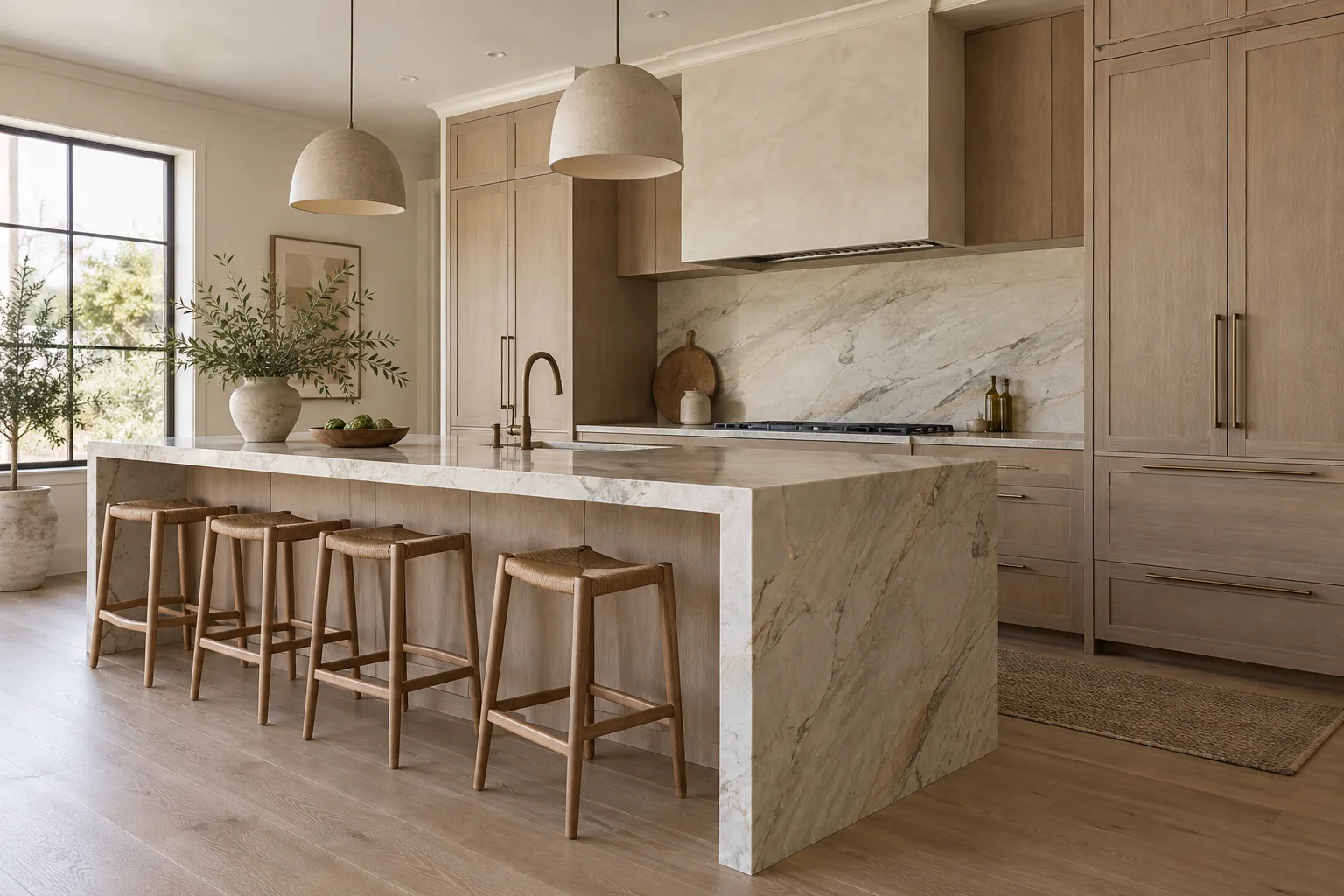
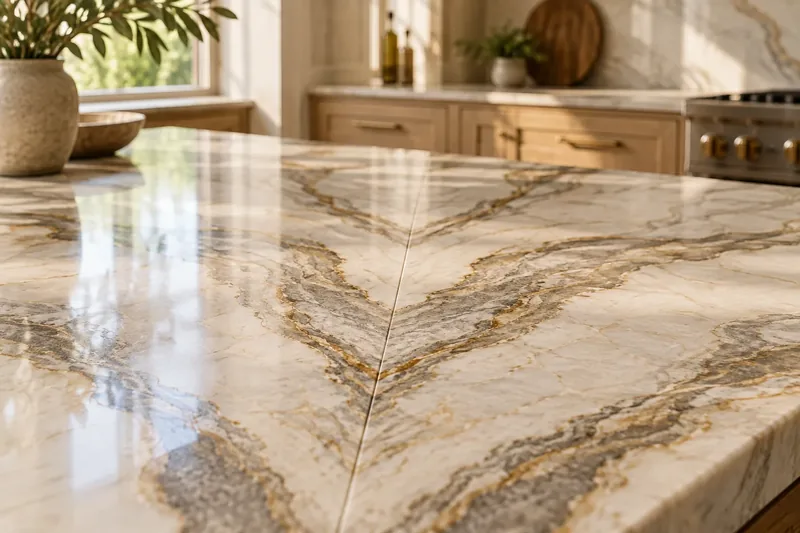
A waterfall edge countertop in Rancho Cucamonga carries its vein from the top down the side because the side panel is cut from the same slab, directly beside the top, and the two meet in a mitered corner. Each piece is cut at 45 degrees along the joining edge, and together they form the 90-degree corner, so the pattern turns the corner instead of stopping at it.
That only works if the layout is planned on the actual slab. The top and the drop are drawn as neighbors on the slab so the veins leaving the top edge are the veins that start the panel. Cut them from different parts of the slab, or from two slabs, and the corner shows a break no polishing can hide.
Why a miter and not a butt joint
A plain butt joint shows the cut edge of the stone and a thick line down the corner. The miter hides the edge of both pieces, which is why a good waterfall looks folded rather than assembled. The trade-off is that a miter is a weak joint on its own, so it is glued with color-matched adhesive, clamped square while it cures, reinforced inside the corner where the design allows, and polished until the joint line is as fine as the stone permits.
Why a waterfall needs more slab
A waterfall costs more mainly because it needs more slab, not just more labor. Each leg is as tall as the counter, and standard counter height is about 35 to 36 inches, so one leg on a 36-inch-deep island adds a panel of close to a square yard of stone. Two legs double that.
Area alone understates it. Because each leg must come from the part of the slab next to the top to keep the vein continuous, the layout decides which parts of the slab are usable, and the leftover is often too narrow for anything but a short splash. On a long island with legs at both ends, that can turn a one-slab job into a two-slab job.
- One leg on a peninsula: usually the least extra stone.
- Two legs on an island: two full-height panels matched to both ends of the top.
- Legs plus a mitered front apron: the most stone and the most miter work.
This is why we check yield on your chosen slab before you commit to the design. A waterfall discovered to need a second slab after the order is placed is the most common way this upgrade goes over budget.
Stones that suit a waterfall
Stones with strong, directional veins show off a waterfall best, and uniform stones hide it. Marble and quartzite with long movement are the classic choice, and engineered quartz with a vein that runs the length of the slab works well too. A speckled granite makes a crisp waterfall that reads as a solid block rather than a fold.
Bookmatching is a separate idea that pairs well with a waterfall. Two neighboring cuts from the same block are opened like a book so they mirror each other, and on a wide island that mirror can sit at the center seam of the top while the legs carry the vein down each end.
Thickness at the corner
The miter shows the full thickness of the stone at the edge. A 3 cm slab reads heavier and more architectural. A 2 cm slab can be given a built-up mitered edge so it looks thicker without the weight, which also keeps the leg lighter on the floor.
Estimated waterfall edge costs
Adding a waterfall edge in Rancho Cucamonga is typically estimated at roughly $1,500 to $5,000 on top of the countertop itself, and the number of legs and whether they force an extra slab move the figure most. The miter work, the polish on each corner and the floor preparation add labor, but stone yield is the big driver.
- Number of legs, and whether a front apron is mitered too.
- Whether the legs push the job onto another slab.
- Material group, since premium quartz and quartzite cost more per slab.
- Stone thickness and any built-up mitered edge.
- Vein matching, which can leave more of the slab as offcut.
- Levelling or protecting the floor where each leg lands.
These waterfall numbers are estimates and can change with slab pricing and the size of your island. The written quote after the template visit and slab layout is what sets your final price.
The template visit and slab layout for a waterfall
A waterfall is templated on the finished island base with the flooring already down, because the legs are cut to the real height between the floor and the underside of the top. We record the base's length, depth and any out-of-square corner, then build the layout on your chosen slab with the top and each leg drawn side by side.
You see that layout before any cutting. It shows where the vein leaves the top, where it enters each leg, where any seam on the top falls, and how much of the slab is left over. If the design needs a second slab, you find out here, while changing to one leg or a narrower apron is still an easy decision.
- Choose the slab first, then the leg count, not the other way round.
- Decide on outlets or a microwave drawer in the island end before the leg covers it.
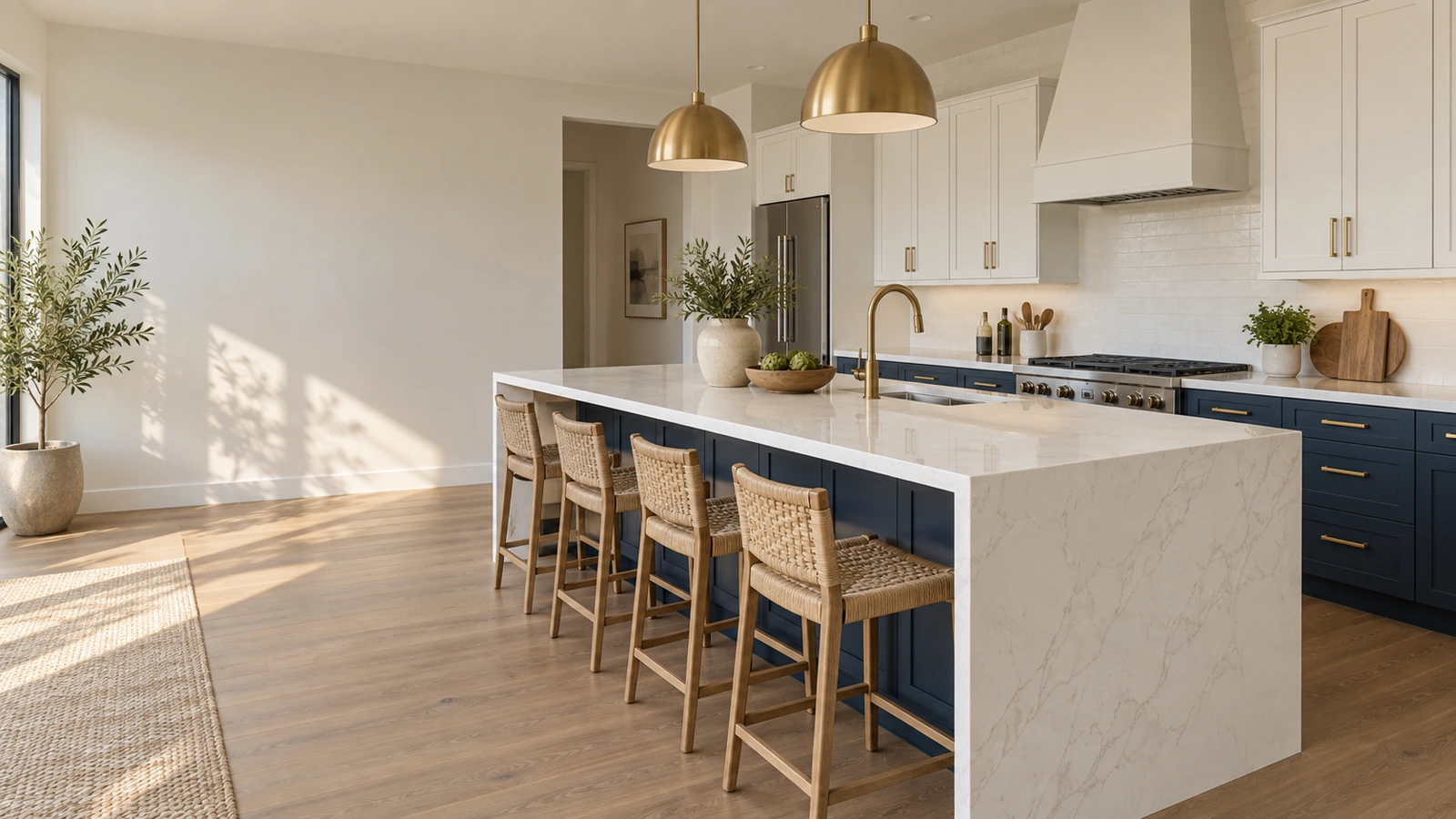
- Plan stool spacing so the legs do not crowd the seats at either end.
Floors, legs and protection
A waterfall leg rests on the floor, so the floor under it must be level, finished and protected before the leg is templated. The panel carries part of the island's weight straight down, and a floor that dips leaves the miter open at the top or the leg standing short of the floor.
- Finished flooring goes in first, so each leg is cut to the real floor height.
- A felt or rubber pad under the leg protects hardwood, vinyl and tile.
- We check level along each leg's footprint at the template visit.
- An out-of-square base is corrected before templating, because a miter shows every error.
Bar stools, pets and vacuum cleaners all meet a waterfall at floor level. A small eased radius on the bottom edge of the leg saves it from most chips.
Waterfalls for designers and remodelers
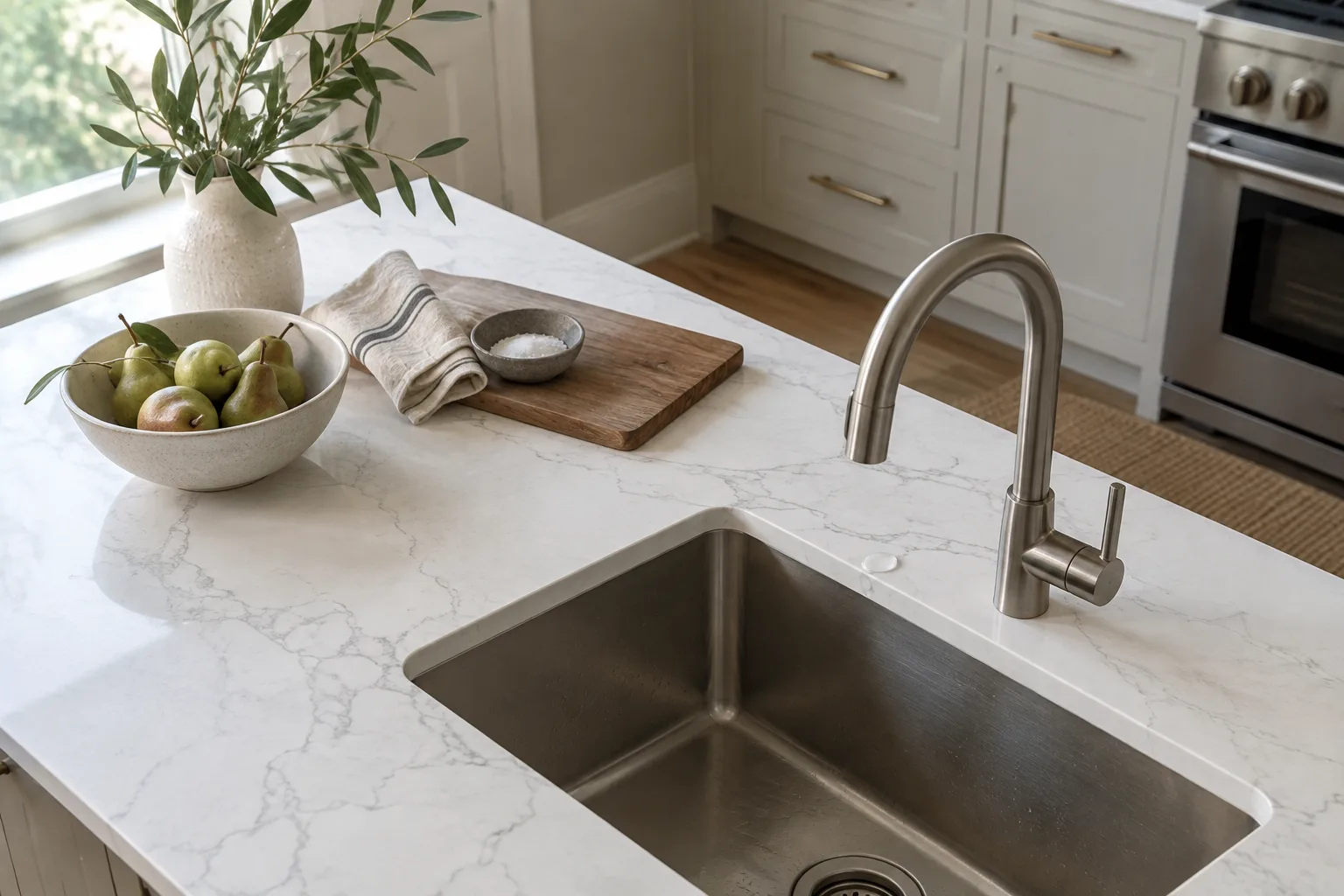
Designers and remodelers who specify a waterfall can send the island drawing with the leg positions and the chosen slab. We confirm yield against that slab before your client signs, so the design, the slab count and the budget agree from the start, and we template on the installed base once the flooring is down.
Finishes and Edges We Fabricate
The process
From First Call to Finished Top
Four steps, and nothing is cut until you have approved the slab and the seam layout.
Call or send the form
Homeowners book a free template visit. Contractors and builders send plans and a finish schedule for a bid.
Choose the slab
You pick the material and the slab, and we mark where every seam will fall before it is approved.
Template and fabrication
We template on your installed cabinets, then cut, edge and polish the tops in the shop.
Install
The same crew sets the tops, fits the sink, joins the seams and leaves the room clean.
Questions
Waterfall Edge Countertops: Common Questions
How is a waterfall edge countertop made so the veining flows down the side?
The side panel is cut from the same slab right beside the top, and the two are joined in a 45-degree miter so the vein runs over the corner. We plan both pieces on your actual slab before any cutting.
Does a waterfall edge need a second slab?
Sometimes. Each leg is roughly counter height, so two legs on a long island can push past what one slab yields, and we check that on your chosen slab before you order.
How much does a waterfall edge add to the price?
A waterfall typically adds an estimated $1,500 to $5,000 in Rancho Cucamonga, mostly from the extra stone it needs. Your written quote, drawn up after the slab layout, sets the final price.
Can you add a waterfall to my existing island top?
Rarely, because a new leg would not come from the same slab and the vein would break at the corner. A waterfall is normally a new top and legs cut together.
Is a mitered corner strong enough?
A miter alone is a weak joint, so it is glued with matched adhesive, clamped square, polished, and the island base carries the top above it. The leg is decorative and structural at once, which is why the floor under it matters.
Can a waterfall go on a peninsula?
Yes. One leg on the open end of a peninsula is a common layout and usually needs the least extra stone of any waterfall design.
Which cities do you install waterfalls in?
We install waterfall islands across Rancho Cucamonga and in Chino Hills, La Verne, Fontana, Upland and Ontario. Give us your address and we will set a time to template.
Does waterfall work come with a written warranty?
Yes, installed waterfall work comes with a written warranty, handed over at install.
Talk to us about waterfall edge countertops
Homeowners get a free template visit. Contractors and builders can send plans for a bid.
Licensed, bonded & insured · License #585047. Calls only, we do not receive text messages.