Skip to content
Call (909) 922-1858Licensed, bonded & insured · License #585047

Concrete Countertops, Precast or Poured in Place and Cured Right

Rancho Cucamonga Custom Countertops is San Bernardino County's trusted specialist for concrete countertops in Rancho Cucamonga, CA, specializing in precast kitchen pieces, cast-in-place pours, and integral concrete sinks. We offer pigmented concrete islands and custom-shaped vanity tops.

  • Free template visit
  • Seams approved before a cut
  • One written quote

Get a free template visit or a bid

Or call (909) 922-1858. Calls only, we do not receive text messages.

About our concrete countertops

Our team provides mold-building and full curing before any sealer goes on, delivering handmade countertops with shapes and colors that stone cannot match, for kitchens, patios and designer-led builds, for both residential and commercial projects. We template on your installed cabinets first, and we return to seal the pieces only after the concrete has cured.

From decorative embedments set in the mold face to a coved sink formed in the same pour, our team handles every detail. Serving Rancho Cucamonga, Claremont, Upland and Chino, we plan each piece around its weight and its curing time so the finished top is ready when the sealer says it is.

How we work

One Crew From Template to Install

Homeowners get a free template visit. Contractors, cabinet shops and builders get tops to their schedule.

Same crewThe crew that templates your cabinets is the crew that installs the tops
Seams approved firstSeam layout marked on your chosen slab and approved before anything is cut
Cut in the shopEvery cut made wet in the shop, never in your home
CA License #585047Licensed, bonded and insured

Precast or Cast in Place

Concrete countertops in Rancho Cucamonga are made one of two ways: precast in a mold in the shop and set on your cabinets like stone, or cast in place, where the forms are built on top of your cabinets and the concrete is poured in your kitchen. The choice decides how messy the job is, how long you live without a counter, and how the top can be shaped.

Precast

Cast face-down in a mold, so the side that touched the smooth mold becomes the finished top. Cured, ground and finished in the shop, away from your kitchen. Easier to control curing, because shop temperature and moisture are steady. Needs seams between pieces, since a whole L-shaped run is too heavy to carry as one casting.

Cast in place

Formed and poured on top of the installed cabinets, sometimes called the top-up method. Can run long spans with no seams at all. Brings the mess into the house: mixing, pouring, troweling and grinding happen on site. Harder to cure evenly, because a kitchen's air, sun through a window and drafts are not controlled. For most kitchens we lean toward precast, because it keeps the work out of your home and gives more control over curing. Cast in place makes sense for a very long seamless run, an odd shape that would not survive transport, or an outdoor bar where the pour can stay outside.

Curing, Then Sealing

Concrete must cure before it is sealed, and that adds days to a concrete countertop that granite and quartz simply do not need. Concrete gains strength as it cures, and over 90 percent of a mix's final strength is typically reached within about four weeks. Countertop makers generally let a top reach full cure, about 28 days, before the final sealer goes on.

Curing is not just waiting. The concrete has to stay damp so it hardens slowly and evenly; if it dries too fast, it shrinks while it is still weak and cracks more. In the shop, curing covers or blankets hold the moisture in. On a cast-in-place pour, the kitchen itself has to be managed: wind, a hot window and a dry day all pull water out of fresh concrete faster than it can safely lose it.

What sealing does

  • Concrete is porous, so without a sealer oil, wine and acidic foods can stain or etch it.
  • A sealer with a high solids content also fills fine surface cracks as it cures, instead of shrinking away from them.
  • Sealers are maintained over time, and we tell you what yours needs when we hand over the top.

This is why a concrete job has two visits at the end instead of one: the set, and the seal. We return to seal after the cure, not before.

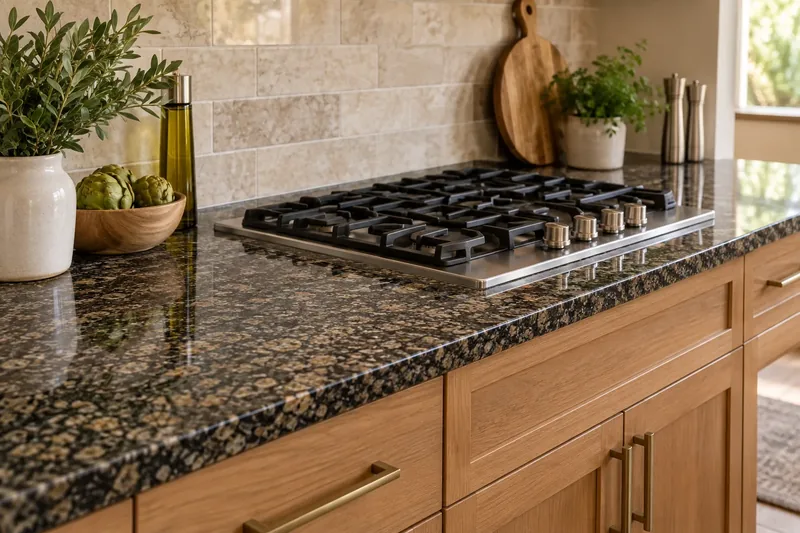
Dark speckled granite counter with a stainless gas cooktop set into it, above white oak cabinets

Cracks, Color and Character

Hairline cracks are normal in concrete countertops and are a trait of the material, not a failure of the top. As concrete cures, it shrinks slightly, and that shrinkage can leave fine, non-structural cracks even when the top is well reinforced. Industry guidance on concrete countertops treats these hairlines as part of each piece's character.

What we do about it is control, not promise:

  • Reinforcement with steel mesh, rebar or fibers, which holds the concrete together and keeps any crack tight.
  • Short-cut polymer fibers in the mix, which reduce shrinkage stress during curing.
  • Slow, damp curing, which lets the concrete gain strength before it is asked to resist shrinking.
  • A high-solids sealer or flowable epoxy, which fills and seals a hairline if one appears.

Color and finish

Concrete takes pigment through its full depth, and every piece varies a little in tone, mottling and small air voids. Some owners want a uniform, polished look; others want visible aggregate or a raw, handmade texture. Bring photos of finishes you like, and we make a sample with your mix before we cast the real pieces. If you want a surface that looks identical from one end to the other, engineered quartz is the better match.

What Concrete Countertops Typically Cost

Concrete countertops in Rancho Cucamonga are typically estimated at roughly $65 to $135 per square foot, with the method, the shape and the finish moving the price most. A full kitchen in concrete is usually estimated at around $2,500 to $6,000, and custom shapes, integral sinks and outdoor pieces add to that.

  • Precast or cast in place. Cast in place needs on-site forms and more trips; precast needs molds and careful handling.
  • Shape. Curves, cantilevers, varying thicknesses and sculpted edges take more mold work.
  • Integral sinks and drainboards. Formed in the same casting, they add labor.
  • Finish. Polished and exposed-aggregate finishes need more grinding than a plain troweled face.
  • Pigment and embedments. Custom colors, glass, stone or metal inlays cost extra.
  • Weight and access. Heavy pieces on a second floor or up a steep drive need more hands.
  • Sealer choice. Higher-performance sealers cost more at install and less over the years.

All of these ranges are estimates for Rancho Cucamonga and are subject to change once the design is set; your written quote after the template visit and a finish sample sets the final price.

Shapes Stone Cannot Do

Concrete is poured into a form, so it can take shapes that a stone slab cut from a block never could. That is the main reason to choose it over granite or quartz.

  • Integral sinks and ramp sinks. The bowl or a sloped trough is cast as part of the top, with no seam and no rim.
  • Integrated drainboards. Grooves cast beside the sink carry water back to the drain.
  • Varying thickness. A thin top that thickens at the edge to look like a heavy block, without carrying the weight all the way through.
  • Curves and odd outlines. Rounded islands, angled peninsulas and free-form bar tops.
  • Embedded objects. Glass, stones, shells, tile or metal set into the surface.
  • Outdoor pieces. Concrete does not have the resin that fades in UV, which is why it suits a patio bar, though it still needs sealing and care outdoors.

Designers, remodelers and custom builders can send drawings for a one-off piece, and we build the mold to the design.

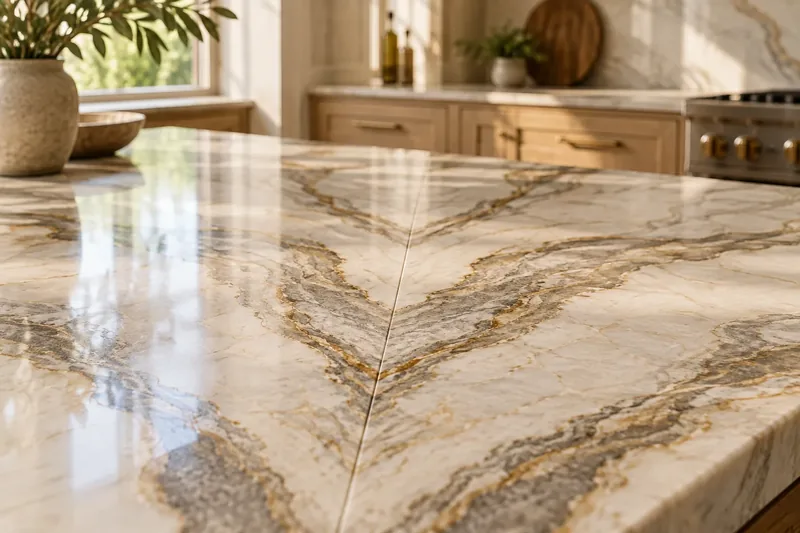
Quartzite counter with gold and grey veining book-matched so the pattern mirrors across the seam

Weight, Cabinets and the Install

Concrete is heavy, so we check the cabinets and the floor under them before we plan the pieces. A thickened edge or a large integral sink adds weight on top of an already dense material. We reinforce cabinets where needed, plan seams so each precast piece can be carried in by the crew, and set the pieces on a bed that keeps them level. On a cast-in-place job, the forms go on the cabinets instead, and the kitchen is out of use until the top has cured enough to strip the forms and finish.

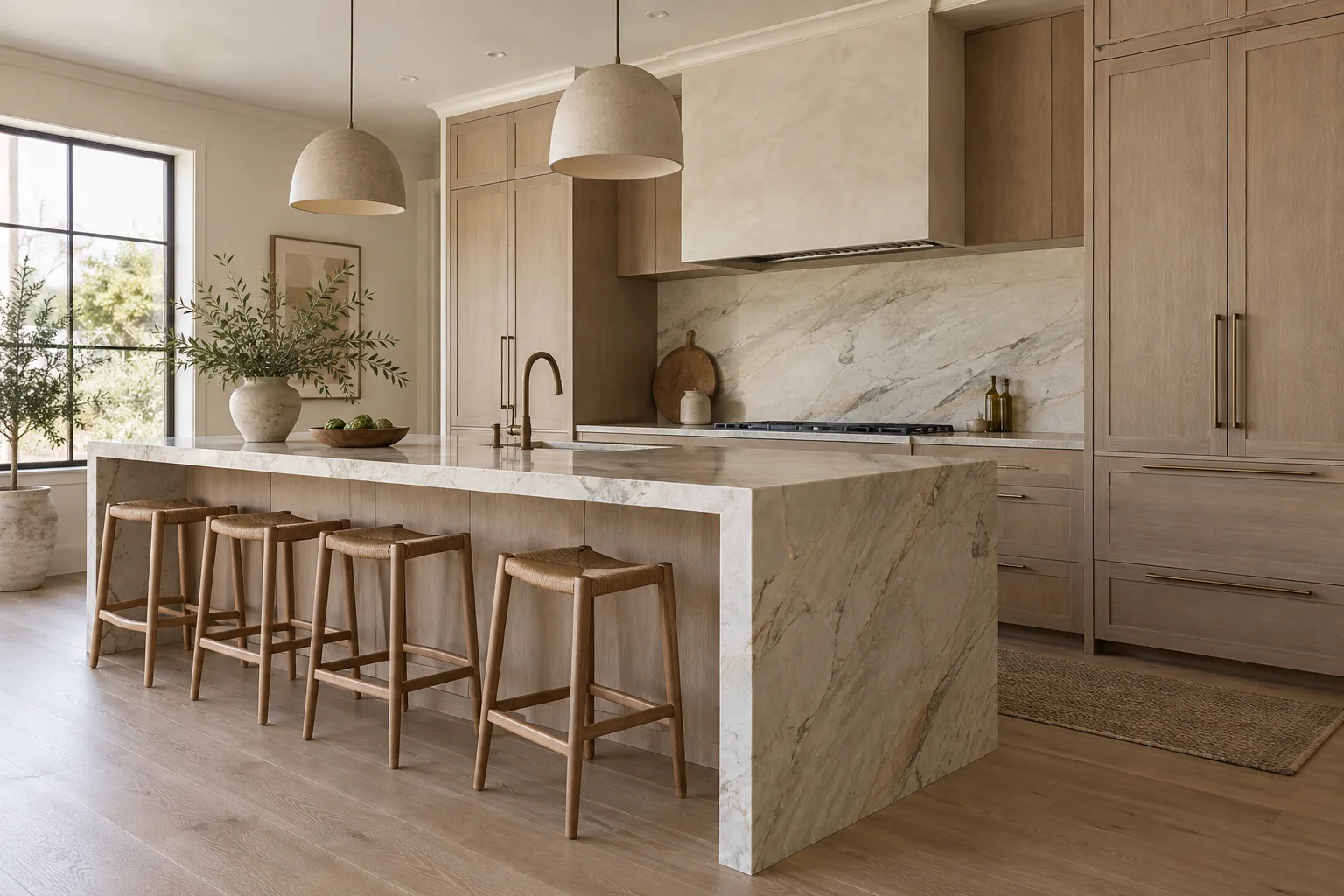
White oak kitchen with a heavily veined stone waterfall island, a matching full height backsplash and woven bar stools

Finishes and Edges We Fabricate

The process

From First Call to Finished Top

Four steps, and nothing is cut until you have approved the slab and the seam layout.

  1. Call or send the form

    Homeowners book a free template visit. Contractors and builders send plans and a finish schedule for a bid.

  2. Choose the slab

    You pick the material and the slab, and we mark where every seam will fall before it is approved.

  3. Template and fabrication

    We template on your installed cabinets, then cut, edge and polish the tops in the shop.

  4. Install

    The same crew sets the tops, fits the sink, joins the seams and leaves the room clean.

Questions

Concrete Countertops: Common Questions

How much do concrete countertops cost in Rancho Cucamonga?

Concrete tops are typically estimated at roughly $65 to $135 per square foot, depending on method, shape and finish. The written quote after we template and sample your finish sets the final price.

Should my concrete countertop be precast or poured in place?

Precast suits most kitchens because the pour, curing and grinding happen in the shop. Cast in place suits very long seamless runs, shapes too fragile to move, or an outdoor bar.

Will my concrete countertop crack?

Fine hairline cracks from shrinkage can appear even on a well-made top. They are non-structural, and reinforcement, fibers and slow curing keep them small. A sealer or flowable epoxy seals them if they show.

How long before I can use a concrete countertop?

A precast top can be set once it has cured in the shop, and concrete typically reaches full cure in about four weeks. We seal after the cure, so plan on a longer timeline than stone.

Do concrete countertops need sealing?

Yes. Concrete is porous, so it needs a sealer against oil, wine and acidic foods, and the sealer is maintained over the years.

Can I have a sink made of concrete?

Yes. An integral or ramp sink can be cast in the same piece as the top, with no seam or rim between counter and bowl.

Are concrete countertops good outdoors in Rancho Cucamonga?

Concrete suits outdoor bars and kitchens better than standard quartz because it has no resin to fade in sun, but it needs a sealer made for outdoor exposure.

Can my existing cabinets hold a concrete top?

Most sound cabinets can, since a concrete top is heavy in the same way stone is. We check the boxes and floor at the template visit and reinforce where needed.

Free template visit

Talk to us about concrete countertops

Homeowners get a free template visit. Contractors and builders can send plans for a bid.

Call (909) 922-1858

Licensed, bonded & insured · License #585047. Calls only, we do not receive text messages.

Call (909) 922-1858Licensed, bonded & insured · License #585047